
American Woman
All hail Minnie, the indelible heroine of Puccini’s La Fanciulla del West, the composer’s California Gold Rush opera that first played on the Met stage and returns this season in a new production led by a bright new star in the title role. By William Berger
A new Met production of Puccini’s La Fanciulla del West is always an occasion and has been ever since the opera’s world premiere—the first commissioned by the Met—in 1910. That legendary night boasted the composer in the audience, with the production directed by the drama’s author, David Belasco (the leading theater producer of the day), conducted by the Met’s Principal Conductor, Arturo Toscanini, and featuring an unsurpassed cast headed by Emmy Destinn, Enrico Caruso, and Pasquale Amato. It was a clear declaration to the world that the Metropolitan Opera had arrived.
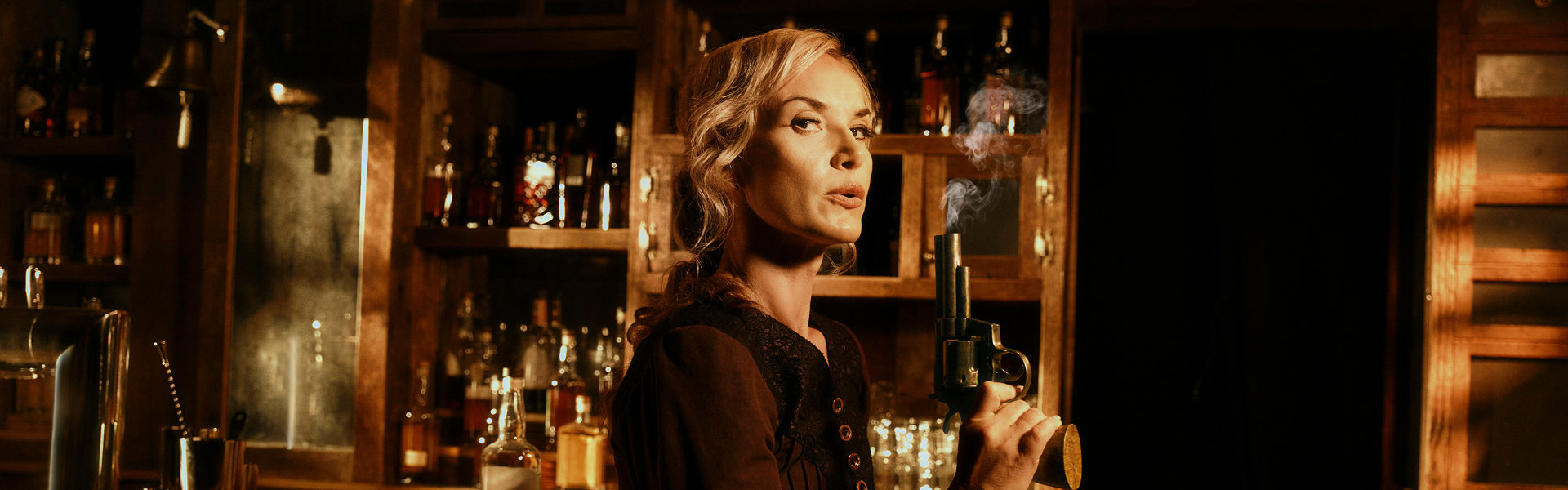
That sense of celebration and momentousness will return to the opera house on New Year’s Eve, when director Richard Jones’s vivid new production has its company premiere, with Keri-Lynn Wilson on the podium. Lithuanian soprano Vida Miknevičiūtė makes her eagerly anticipated Met debut as Minnie, the gun-toting, saloon-owning girl of the golden west, opposite tenor SeokJong Baek as Dick Johnson and baritone Christopher Maltman as Jack Rance.
Caruso, Destinn, and Amato in the 1910 world premiere of La Fanciulla del West at the Met
Although he advances the action from the mid-19th century to the first half of the 20th (making electricity possible in Minnie’s bar), Jones doesn’t so much reinvent the original as apply a dramaturgical lens that centers the story on the camaraderie of the California Gold Rush miners, explores Minnie’s inner life, and supports and amplifies Puccini’s and Belasco’s dramatic aims. The action-packed production is replete with bar brawls, high-stakes poker matches, and a near-execution. This Fanciulla maintains the realism that made it so striking at the work’s opening.
The composer himself would likely be pleased, as that spectacular 1910 premiere and the various critical concerns of the times seem to have clouded opinion of the opera itself over the years. Was Puccini, many wondered, perhaps too popular, too commercial to be considered as seriously as the Serialists and Modernists of those turbulent times? And what is one to make of a grand opera set in grungy materialist America using American themes and tropes?
If Fanciulla never became as central to the repertory as some other Puccini operas, it isn’t because of any shortcomings in the piece itself but because of the unique challenges of producing it at the same level of quality that it received that legendary first night.
A scene from Jones’s new production
The orchestral score is not only Puccini’s most lush, it also conveys an extraordinary degree of the interior and external drama. Then, there are the demands on all the singers: Minnie, the “girl” of the title, needs not only a heroic voice but also an extraordinary gift for characterization. She must be convincing while giving a Bible lesson, firing a gun, landing a punch, and cheating at poker—a true Western archetype. The casting challenges extend through the entire large cast, which were all assigned to major singers in 1910 (one example: Antonio Pini-Corsi, one of eight miners in the cast, had been chosen by Verdi to create the role of Ford in Falstaff and by Toscanini to sing Schaunard for the world premiere of La Bohème).
In terms of a visual approach, many productions over the years have opted for a sepia-toned, storybook effect, but this adds a filter of romanticism essentially at odds with Puccini’s gritty realism. Jones’s new production takes the work at face value, inviting the audience to find the inherent transcendence and mythos within the sludgy California setting. That’s the real heart of gold in this work. Minnie may be recognizable, but she is also an agent of redemption (an “angel,” as the hero Dick Johnson calls her in Act I) for an entire little world. She is an American avatar of a Wagnerian mythic hero, and the redemptive transformation of her community makes Fanciulla a convincing and deeply human analogue of Parsifal, which Puccini admired intensely. More than a century after its premiere, it is standard among Puccini fans today to say that with this work’s scope, expression, and accessible grandeur, La Fanciulla del West is his masterpiece.