
Cinema Scope
With the Live in HD series of movie-theater performance transmissions—celebrating its 20th anniversary this season—the Met redefined the way an opera company could share performances with a global audience. On the occasion of the program’s two decades of excellence, a number of its key players shared their thoughts on what it took to get this groundbreaking initiative off the ground. Herewith, our oral history of the launch—and impact—of Live in HD. By Matt Dobkin
PETER GELB Met General Manager and Executive Producer of Live in HD Long before our live cinema transmissions were a sparkle in anyone’s eye, I was running the Met’s media department in the 1980s on a freelance basis. Since my goal has always been to create events that could have the biggest possible impact on the largest number of people, I tried to apply that logic to what we were doing at the Met back then, which is what led us to produce the Otto Schenk Ring cycle for television, an unprecedented broadcast over four nights in prime time on PBS. It was the highlight of my earlier Met career running the media department.
JULIE BORCHARD-YOUNG Owner and founder, with her husband, Robert Borchard-Young, of BY Experience, a global distributor of alternative cinema content that has worked with the Met since the inception of the HD series. In the early 2000s, I was Senior Vice President of International for the Sony Music group of companies in New York, and Peter was one of my bosses. I worked on many different strands of repertoire, depending if it was Columbia, or Epic, or whatever the Sony label was. And Sony Classical, which Peter ran, was one of the divisions that was my responsibility. That’s how I first started working with him.
PETER GELB When I was appointed General Manager of the Met in 2005, I had a one-year transition period to think about new initiatives that the Met might undertake to expand its presence locally and internationally. When Julie was on the marketing team at Columbia Records, she experimented with launching a new David Bowie album with an international press event connecting journalists and fans in cinemas using digital projectors and satellite technology, and she suggested that the Met think in these terms. Around the same time, Beverly Sills, then Chairman of the Met Board, showed me a photo of opera fans huddled around a radio in a midwestern gymnasium listening to a Met Saturday matinee radio broadcast, which conveyed the communal appeal that opera offers. Since the Met already had a loyal radio audience, it seemed like a worthwhile experiment to offer those listeners an opportunity to see the operas, as well as listening to them.
JULIE BORCHARD-YOUNG Robert and I had worked on this Bowie event in 2003, when David had an album called Reality that we were launching. This was before streaming, before any real use of satellite technology, except in broadcasting. Knowing that Bowie was always interested in groundbreaking events, we proposed to preview his new album, with his band, by beaming it live into cinemas across Europe. The results were huge, with about 50,000 people and packed theaters. The album went to number one on the charts everywhere. When I read about Peter’s appointment to the Met, I explained to him how the Bowie event had worked, and he was intrigued. We agreed that I would put together a distribution plan for the Met.
MIA BONGIOVANNI Mia Bongiovanni’s first job out of college was at the Met, working in Gelb’s media department, after which she joined him at Sony. When he returned to the Met, he brought her with him, first as a consultant, then to run the media department and be Supervising Producer of the HD series. At some point during Peter’s transition year, I came in for a meeting he was having with Julie to talk about this new idea. I have a memory of sitting around a huge conference table, and Julie was talking to him about the shows that she had done. And I remember, in Peter fashion, what started as a conversation about an idea to try out one show immediately grew. I remember him saying, “If this is going to be successful, it has to be a series, and it has to be year after year.” It immediately became a very big idea, one of many media ideas that started percolating for him, including the SiriusXM Met radio channel.
PETER GELB We had to convince all the unions at the Met to agree to embark on this experiment because their contracts at the time didn’t provide for this kind of distribution. We had to plan on the union negotiations being successful and on the Board of Directors approving the plan, not to mention the movie theaters agreeing to carry the programs, as well as getting the support of the opera stars to accept the added pressure of having their performances seen live, since they were going to be the public face of this venture. All these negotiations had to happen simultaneously if we were to launch in time for the start of my first season in 2006.
MIA BONGIOVANNI You can’t emphasize enough the tectonic cultural shift that needed to happen here. The Met was not producing a lot of media activity by 2006. The mentality of actively promoting the art form and growing the audience and trying to bring it into the cultural mainstream simply was not prioritized in that period. So the cultural shift was transformative.
PETER GELB I made a point of contacting 20 of our leading stars, including Renee Fleming, to make sure that we had all the top singers on board, and that would help persuade other artists to agree, as well. Most of them were excited but nervous about the idea. In the end, though, it’s had a very positive impact on the quality of performances. I remember James Levine telling me that whenever there was an international radio broadcast, the singers always sang better, like great athletes at the Olympics. The higher the stakes, the more records are set. The same is true with opera singers, who are the vocal athletes of the performing arts.
RENÉE FLEMING From a performer’s perspective, you cannot imagine how exciting it is to be able to broadcast a beloved role to people outside of the opera house. And more importantly, it becomes part of our legacy, which is something we don’t have if it’s not captured. There are so many great singers who we’ve never heard and wish we could have heard.
Another key figure Gelb met early on in his planning was TV director Gary Halvorson, who was acclaimed as a director of sitcoms like Friends and Two and a Half Men, as well as the Macy’s Thanksgiving Day Parade. Halvorson had directed a few Met PBS telecasts before the launch of the new cinema series, so he knew Met producers Louisa Briccetti and Vicki Warivonchik, who had been at the Met for a number of years and now worked with Bongiovanni as the HD series neared its launch.
GARY HALVORSON Louisa said to me, “You have to meet Peter Gelb.” He had just been instated at the Met, and at that time, I was directing Friends and Everybody Loves Raymond and all these big shows. I said to Louisa, “I’ll meet him as long as you think he’s open to doing something new.” I had just seen the Olympics, and I was watching the 100-meter dash, right? And this camera was on a track, and it was running along with the runner—and it was beautiful. I thought, Why can’t we do something like that in the opera? I said, “Peter, why can’t we do cranes and stuff? This dolly camera can go running across the front of the stage, nobody will see it, and it’s quiet.” And we ended up with one of the first versions of this dolly, which actually became the iconic thing for me as a new way of shooting opera.
MIA BONGIOVANNI Peter and Gary completely hit it off the very first conversation they had. They were feeding off ideas and talking about sports metaphors. So Gary was absolutely instrumental because he matched Peter’s outsized vision.
PETER GELB What’s remarkable about Gary is that he combines musicianship and artistry with being an unflappable director of multicamera live transmissions. He can read a score inside and out, even though there’s a score reader sitting next to him in the TV production truck. Gary has the nerves of steel necessary to direct a live multicamera show. But since he’s also an artist, it’s kind of like being a jet fighter pilot and an auteur at the same time.
GARY HALVORSON I started out as a jazz player, on the Hammond B-3 organ, when I was in high school. In college, I studied piano, starting with Bach, of course, and I fell in love with classical music. One night, as a student in Boston, I was watching Arthur Rubinstein on Great Performances, and they were cutting from Rubinstein’s hands to his face, and then back to his hands. But when they do that, they were missing the point—they were not capturing what Rubinstein’s soul was saying to him through that music. And I said, Why are they showing his fingers? Who cares about his fingers?! It’s all in his head and his face! So I called up the producers and criticized the production. I said, “You know, it felt like you were shooting the wrong thing at the wrong time.” The producer says, “You’re a music student, right? We just started an intern program. Why don’t you come down and see if you want to get involved with us over the summer?” So I went to New York, and I met all these legendary directors who were doing symphonies and opera and everything else on television, and I immediately said, “Oh, this is what I’m supposed to do.”
MARK SCHUBIN The series’ Engineer-in-Charge, Mark Schubin is responsible for all the technical aspects of each transmission. He’s also the company’s resident guru and unofficial historian of all things related to opera and media, having started in the 1970s on early TV broadcast efforts. I was told about the HD project by Louisa Briccetti, and my first reaction was, That’s the stupidest idea I’ve ever heard. We had had Live from the Met on PBS, and the first one, La Bohème, on March 15, 1977, was possibly the highest rating that PBS had ever gotten. A huge audience. With Live in HD, I thought, You’re going send this out to movie theaters, and people are going to have to pay money to go into the movie theater and watch the thing? I was tremendously wrong.
PETER GELB One of our mandates was to figure out how to shoot the Saturday matinees without disturbing the audience in the opera house. I’d been to too many live shows where you have to wait interminably for the TV production to be ready, where audiences in the house feel like they’re being treated like second-class citizens. I wanted our audience in the opera house to feel good about being at the epicenter of a global event, and that they weren’t suffering as a result of it.
MIA BONGIOVANNI The learning curve was huge, but the Met had been doing television for a long time, and the team here, and the freelance crew that ultimately came in to work on HD, had a long history with the Met. So there was, thankfully, a really strong foundation of knowledge.
MARK SCHUBIN I started out working as a consultant for the Media Development Department at Lincoln Center. The first thing we did, as an experiment, was The Tales of Hoffmann at the Met on December 3, 1973. I was the technical consultant. There was an experienced television producer and a television engineer who were going to deal with this production, but when we explained the criteria—you can’t increase the lighting, the cameras have to be invisible, microphones have to be invisible—the producer said, “I will not allow my reputation to be sullied by this project!” So they left, and I became de facto engineer-in-charge. After that Hoffmann, we came back and shot Cav/Pag in ’74.
The La Bohème telecast of 1977 on PBS, featuring Renata Scotto and Luciano Pavarotti, is generally considered the Met’s first foray into live video performance transmission, but in fact the origins are even earlier.
The series built on a 1952 experiment beaming Carmen into cinemas.
MARK SCHUBIN Actually, you can go back to 1877. There was an article in The New York Sun on March 30 that year about this new technology. The idea was that you would have something called a telectroscope, and a single opera being performed in one theater could be seen in theaters around the world, live. That was the earliest mention of this. The Met actually broadcast on the radio in 1910, and that was ten years before the first radio station in the United States. Later, RCA had theatrical projection television. Prize fights were carried that way. There was a company to assist with these theatrical television projects called Theater Network Television. I’m not sure if they were hired by the Met, or if they approached the Met, but in 1952, they carried a live Met performance of Carmen to a few theaters around the country, and the one in New York was what used to be the Guild Theater on 50th Street. People paid to go see Carmen in a movie theater in 1952. It was black and white, it was AM radio–quality sound, because that’s all that could be transmitted at the time. And except for in New York, there was a problem in the transmission, which at one point got switched to a football game. But the Met Archives has the audience-comment cards, and no one talks about the football game. They all just say, “This is the most wonderful thing ever, and the pictures are wonderful, and the sound is wonderful,” and so on. So that was the first, and that was it for the Met for theatrical television, until the HD project.
BRAD LaDOUCEUR As Vice President of Event Cinema and Distribution with Cineplex, in Canada, LaDouceur has been a partner and champion of the series since the first season. I’ve been with Cineplex for 42 years. In 2006, we were looking at business development, and partnering with the Met had to be brought before our board. We had done some small event-cinema programs with Julie and her, husband, Robert, so we brought this idea to our CEO, and we had two real cheerleaders on our board, who said, “Open your doors. People are going to come out. They’ve been listening to the Met on the radio forever. They catch it on PBS when they can. To be able to see it live would be a game-changer.” I was all in. I think we started at 16 locations initially, and it just exploded. We had sellouts within weeks of tickets going on sale. And today we’re in more than 100 locations across Canada.
Tenor Matthew Polenzani and blue bear in the series-launching transmission of The Magic Flute
On December 30, 2006, the series launched with a live transmission, into eight countries, of Julie Taymor’s production of Mozart’s The Magic Flute, sung in English. Taymor was in the audience at the Walter Reade Theater in Lincoln Center, across the street from the Met.
JULIE BORCHARD-YOUNG That day was great. I was at the Walter Reade, and I looked around, and people were buzzing, as well as journalists, and I just thought, This is cool, this is cool. Julie Taymor sat maybe two or three rows ahead of me. It was a full house, completely packed. I didn’t know what was going to happen, but it was beautiful. And when the production ended, Julie went back across the street to the Met to do her bows on the stage, and the Walter Reade roared with applause.
Julie Taymor, the production’s director, watched from the Walter Reade Theater.
PETER GELB When reports started coming in that the audiences in movie theaters were applauding, I realized then that it was going to be successful. Because that was the whole idea: to take that moment that Beverly Sills had shown me of people gathered around a radio and expand it into a communal experience inside cinemas.
MIA BONGIOVANNI I was in the production truck during Flute. The moment that will always stick with me is at one point, with the dancing puppets, that polar bear puppet jumped up and floated forward and magically landed right in front of a camera so that its face was full-frame on the screen. I remember all of us in the truck laughing, because it was just so perfect. I think that’s when it hit home for all of us, that we were doing something special.
GARY HALVORSON I was scared out of my wits, first of all because I didn’t know if it was going to work. And Julie Taymor, who had done The Lion King—this was a huge director to be at the Met! At one of the first camera rehearsals, I was shooting a wide shot I needed to study, and she hated it. Peter said, “You’ve got to go talk to her.” So I went and sat next to Julie and talked about the shot, and I remember she had some great notes she gave me. After the show, we all went up to Peter’s office, and she came running down the hallway, screaming, “Yes, yes, yes, that was so great!” It was thrilling to have that moment.
Mark Schubin, circa 1983
MARK SCHUBIN The first show, we did the subtitles the same way we had done them for Live from the Met, which was basically a title generator, with an operator sitting there and advancing the titles. By the second one, however, we added Germany, because the Germans wanted German subtitles. So we doubled up on everything. But it was pretty clear that that wasn’t going to be sustainable. So I went to the International Broadcasting Convention, where people deal with subtitling, and started talking to all the various subtitling vendors. We ended up creating the first multilanguage live subtitling system. Now it’s widespread—basically everybody who is doing live opera transmissions in multiple languages is using the system that we first came up with.
JULIE BORCHARD-YOUNG It took one show, that Flute, and then the press broke, and there was a fervor about this idea. We set up systems for cinemas to apply, and then the phone calls would come in about what technology was required, because the cinemas had to invest in satellite equipment and upgrade their projectors, which a lot of them were willing to do. We just ran as fast as we could.
Barbara Mortensen with students at a Live in HD screening
BARBARA MORTENSEN Based in Rancho Mirage, California, near Palm Springs, Mortensen right away became a Met HD Ambassador and advocate for the series in her region, where she is known as the Opera Lady. I was born and raised in New York City, okay? I went to Public School 217 in Brooklyn, I graduated from Brooklyn College, I took piano lessons at Juilliard. I’m a true-blue New Yorker. My parents took me to my first opera at the Met when I was five years old. I was overwhelmed, and I’ve never forgotten that feeling. When I heard that the Met was going to be starting the Saturday transmissions in HD, I said, I have to figure out a way to get it to the desert because we need to be part of this. So I traveled 100 miles to Alhambra, which had a theater, and I asked everybody there, the management team, how did they get the program? What do they do? And then I went back to my local theater chains. I knew that we had an audience because we had two different opera clubs here, one of which was to raise money for the west coast Met young artist auditions. Next, I called the Met. My friends thought I was crazy. How do you pick up the phone and call the Met? But I got straight through! They directed me to Julie, and basically what they were hoping for was, could I get an audience? So I went to each of the opera groups, and I made a presentation to their boards. I said, I can get The Barber of Seville in our theater, but I need to fill it 100%. You all need to come, do whatever you have to. And we did. We sold out. Because it’s very hard to say no to me, by the way.
The first Flute broadcast established the template for how the transmissions would be produced going forward.
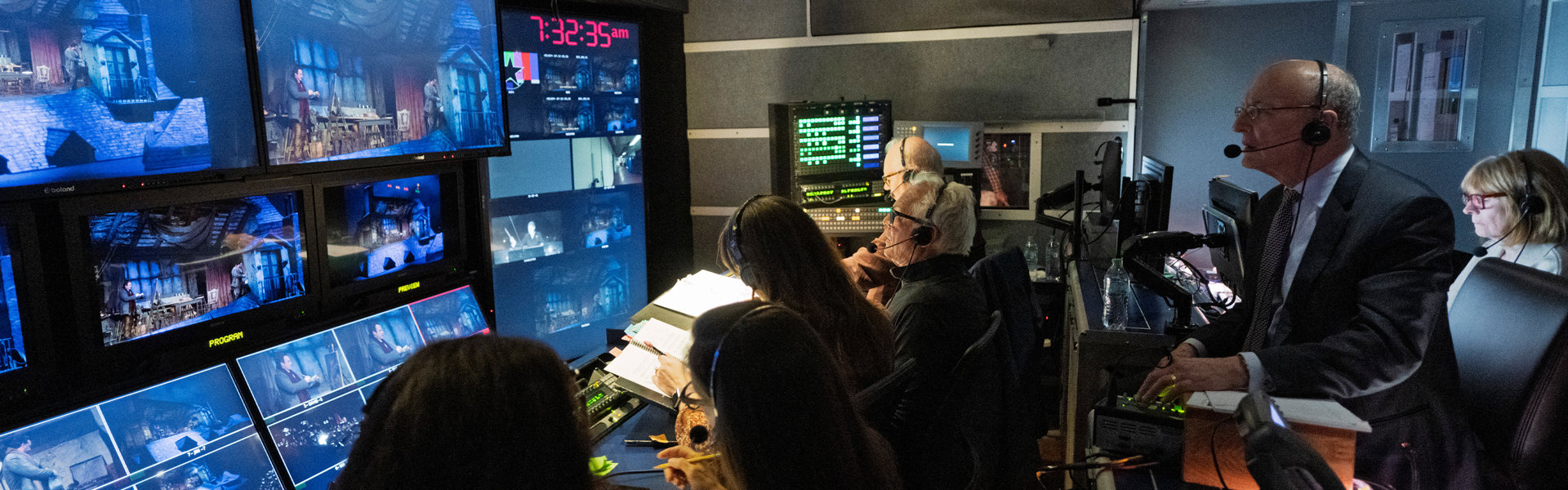
DAVID SMITH Camera Operator I actually began in sports. I spent about ten years shooting sports and then made the transition into what we classify as entertainment. It could be sitcoms to live rock-and-roll shows. With Live in HD, we typically have eight cameras in the auditorium and then a couple more backstage. What’s different with the Met is the choreography that takes place in getting all of those cameras in the right place at the right time. That’s done by scripting. Rock-and-roll is not a scripted show. In our case, everything is scripted. Every shot has a number, and the master list goes sequentially through those numbers, and then each camera operator works from a script of just their own shots.
Camera operator David Smith
MARK SCHUBIN For every show, we do what we call a lighting test, which is just a few cameras, and the television director works to come up with a shooting plan. And then we do a rehearsal, which is the performance before the live transmission. The day before the live show, we do what we call a lighting meeting, and all of the departments of the Met cram into the control room. Peter is there, and anyone who has any issues with the rehearsal footage raises it—a white costume that looks too bright on screen or something. Then we’ve just got a few hours between that and the actual transmission to make all these changes, which is mind-boggling. I don’t think that could be done anyplace but the Met.
DAVID SMITH It’s all compressed into one week. We start on a Monday, and then we shoot the following Saturday live. We rehearse it once. We will meet for probably 12 to 14 hours of camera conference time prior to the rehearsal, over several days, and then we’ll shoot the rehearsal, usually on a Tuesday night. Then Gary will re-script starting on Wednesday, and easily 30% is going to change, because something didn’t work, or there’s a better way, or Gary’s storytelling takes a different turn. Gary and Peter are demanding, as they should be, and they expect that we’re going to do a great show, and the team usually delivers.
MARK SCHUBIN My role is Engineer-in-Charge. The movie theaters don’t have engineers. The bulk of our theaters have a projectionist who is in a multiplex, running 14 auditoriums or something, and maybe has five or ten minutes to watch our test material. For the first show, we did testing of the transmission paths beforehand, and the latecomer that we had was in Tromso, Norway, which is inside the Arctic Circle. We were feeding the U.S, we were feeding Canada, we were feeding the U.K., and we were feeding Tromso, Norway, which was the hardest place to get to. So we’re doing our first transmission test, and about a minute in, Tromso calls and says, “Yeah, everything is fine, we see the subtitles, the picture is fine, the sound is fine.” But nobody else was getting it! The U.S. was not getting it, Canada was not getting it, the U.K. wasn’t getting it. There were all kinds of crazy reasons for this. In one case, it was that the engineer needed to go to the bathroom and left the transmission shack and the door closed behind him and locked, so he couldn’t get back in.
DAVID SMITH I think people would be surprised by the size of the team that makes this all happen. Our utility people are first-rate, world-class people who get our equipment where we need it to be, get our signals from here to there. Our audio crew. People don’t think about audio very much because it’s perfect all the time. But it takes a lot of people and a lot of skill.
GARY HALVORSON One of the things that’s really important is that the camera operators, who I call artists, are integral to the whole process. The cameramen are like my right arm, and when there’s a great performance on stage, everybody rises to that occasion. I may say, “This camera is supposed to tighten in” at a certain moment, but actually what happens is the cameraman instinctively feels the sound of the music, and the singers, in their performance, draw the camera to them. It’s an almost imperceptible thing. What happens then is that miracle when the music, the camera, me, the cameramen, the production, and the orchestra all become one. It’s so powerful and beautiful that it’s un-toppable—you can’t get any better that that. And here’s the cool thing: We’ve never missed! We have never missed that moment—that’s how good these guys are and how sensitive and tuned in.
DAVID SMITH We are taking in a tremendous amount of information during the show. Your mental state can depend a lot on your assignment. You know, one camera might be on, say, the soprano, and it’s going to stay there for a long time. Other cameras may be bouncing around all over the place. So you really have to keep up. And the singers are not going to do the same blocking every time—and we complain about it constantly! So our carefully crafted script can change in an instant, and you’ve got to fly with it. You have to have the confidence to do something that you weren’t assigned to do if the situation changes when you’re on the air.
MARK SCHUBIN I found the success flabbergasting. Seeing that we would break the top 10 weekend box office with just one showing? Amazing. One of my favorite stories was, there was a woman in Connecticut who got into an auto accident, and her car rolled over. The police came and they asked, “Can we take you to the hospital?” “No, we don’t want to miss the opera.”
BARBARA MORTENSEN My thought early on was, I’ve got to get kids involved, because that’s the future of opera. We’re all going to get old and die, but I don’t want opera to die just because I’m not here. So I went to the school districts, and I said, “I’m willing to pay for the tickets.” I would pay for a teacher to show up, I would pay for a parent. I went to all the charity organizations that deal with children’s problems and made it all available for them as well. At this point, I have seen every performance. I missed one Saturday transmission when I had surgery. But I listened to it in the recovery room on the radio.
PETER GELB There have obviously been things that didn’t go right. The performance of Salome, when Deborah Voigt was the host and was supposed to do a live interview with Karita Mattila, who was singing the title role, right before the one-act opera began. Excited by the herculean role she was about to perform, Karita forgot about the interview and refused to come out of her dressing room, leaving Debbie standing outside, trying to ad-lib her way out of it. There was a moment in Prince Igor when Gary, in his enthusiasm, knocked a can of Red Bull into the camera-switching board, making it inoperable and leaving us with only one camera to work with for the final 15 minutes of the second act.
BRAD LaDOUCEUR Snowstorms in Canada were our biggest fear, because the snow sat on top of the satellite dishes and didn’t melt. We had managers going up on their roofs and sweeping the dishes throughout the broadcast to make sure we had signal. And Canadian winters are harsh!
The occasional snafu aside, the predominant sentiment from those in the front lines of the series since its inception is great pride.
JULIE BORCHARD-YOUNG I’m proud that a simple idea became this amazing connection point for opera lovers and brought so many new people into the art form, and that it has reflected so positively on the Met. During a board meeting early in the process, Beverly Sills said, “The one thing we must keep going is Live in HD. The Met has to be a leader, has to take risks. The Met has to show the world that anything’s possible.”
BRAD LaDOUCEUR I’ve been in the industry for a long time, and to be able to put so many people into the theaters to see these productions, and to see the sense of joy they have at the end, that they’re talking about it—that makes me happy. And it truly is the Met that kicked off event cinema globally.
RENÉE FLEMING I cannot overstate the impact this series has had on the world of opera and the performing arts and on the reach and renown of artists. I still remember after a concert in Norway, an audience member telling me that the first time she saw me was in a Live in HD broadcast, and it was packed. That was her introduction. It builds audiences around the world.
MIA BONGIOVANNI The singers, the musicians, the craftspeople, the crew—everyone here at the Met is the best at what they do. And I feel that the HD program has matched that and represented the excellence of the stage on an equal footing. I feel the program has done right by the house.
PETER GELB The Met today has the single largest audience of any opera company in the world because of the cinema transmissions, as well as the radio broadcasts. I’m proud of the impact it’s had on the art form in raising the level of theatricality and the acting levels of the singers. And you think about a city like Tromso, where in the winter, with no sunlight, the Met is there for them. It’s remarkable how the Met has affected so many lives.
GARY HALVORSON I think if my life has any purpose, this is it. It’s only after 20 years that I realize how powerful these 125 Met productions I’ve done have been to my life. Everything that preceded it came full circle to land me in this place. And that has given me so much. It’s an honor beyond.
Matt Dobkin is Creative Content Producer for the Live in HD series.