
Girl Talk
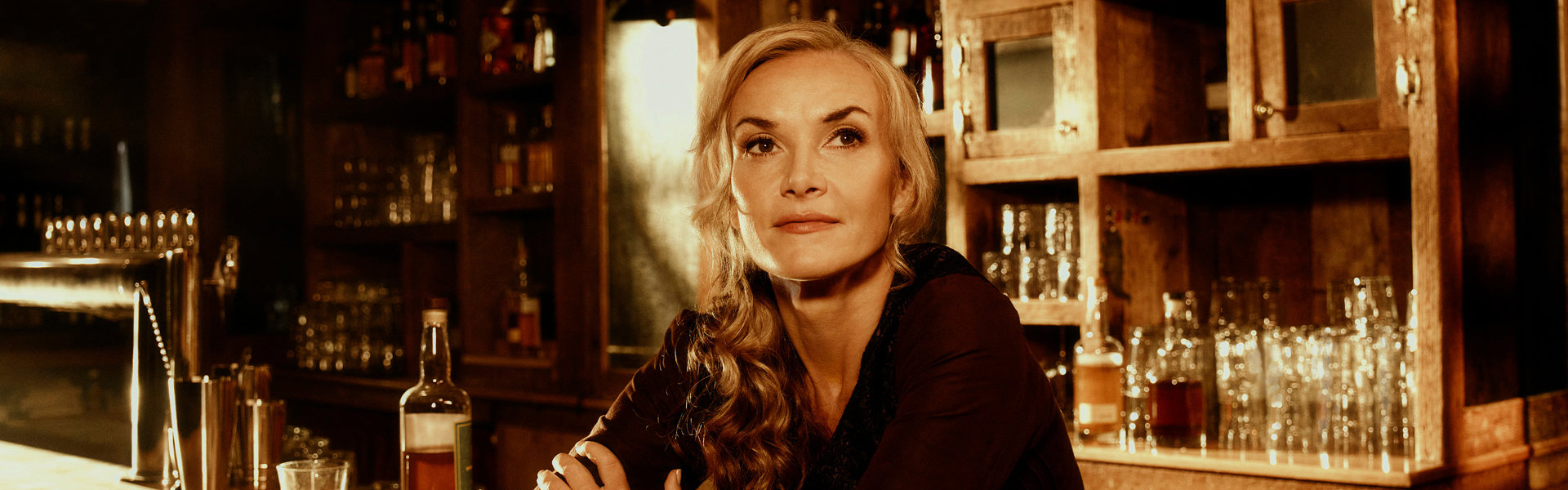
Having conquered European opera stages over the past decade, Lithuanian soprano Vida Miknevičiūtė is poised for a memorable Met debut this season as Minnie, Puccini’s “girl of the golden west.” On her first-ever visit to New York City, Miknevičiūtė spoke to the Met’s Matt Dobkin about the character’s rich mix of strength and sensitivity.
This new Fanciulla del West marks your Met debut, a role debut, and your first time in New York! How are you feeling—nervous, excited?
All these things are unbelievable—it’s still unreal for me. I’m very, very happy and very excited, but right now, I can’t say that I am nervous. When I’m on the stage, I try to enjoy what I’m doing. And I only got the call a few months ago, so I’m starting to learn it, really working on the role, trying to give my best.
What’s your process for learning a new role like this?
I try to find my version in terms of the musical direction and to understand the character and the text. So it’s actually my own very difficult, personal, and not very interesting process, and it’s only for me. After that, I go to coaches, people who know me, who can help me, inspire me. I really want to be precise musically and rhythmically, and to find vocal colors and the meanings of the phrases. What attracts you to the role of Minnie? I think she’s a very strong woman and very sensitive. She is actually alone as a woman in this man’s world, so she must trust in herself a lot. Sometimes, she’s like a teacher for the men around her. But on the other hand, she has never been in love. It’s something new, new emotions, new feelings. So I think you need an intensity from the beginning till the end. Minnie changes in every act, from this strong woman to someone with sensitivity and love.
You’ve sung a lot of Strauss, Wagner, Verdi, and Tchaikovsky. But this is only your second Puccini role.
I’ve been singing mainly Strauss and Wagner for the last five or six years. I think Minnie is exactly on time because I think she’s the most difficult character Puccini wrote for soprano. It’s not just about high notes or low notes—it’s about this intensity, which is exactly what I’ve been doing singing Wagner and Strauss. Fanciulla is a very special opera without big arias like we hear in Bohème or Tosca, where everyone can applaud after. No, it’s just always intense, and it never stops. It just grows and grows. I think it’s the right moment for me to sing it, because you need to have a voice that is very flexible between lyrical moments and very dramatic moments.
Are there any particular moments you’re especially looking forward to?
For me, the important message of it is for everyone to understand that people need second chances. And I think this is a very strong moment to tell people that. To fight for love but to learn how we can also be kind to people and give them a second chance.
You’re new to Met audiences, so tell us a little about your road from Kaunas, the second biggest city in Lithuania, to the Met stage?
My way was very long, actually. When I was five years old, I started to play piano, and I played for about ten years. But after that, my teacher and I decided that maybe I should conduct! So that was something new for me, and as part of my conducting course, once per week a national vocal teacher came and worked with us. And I loved it. So I decided to start a new adventure and be an opera singer. Then it was a long, long way, about eight years of studies, and after that to opera studios in Zurich and Hamburg. I’m very happy, but it was a very long process.
Who have been some of your vocal inspirations?
I was very inspired by recordings from Mirella Freni, from Maria Callas, from Renata Tebaldi—all these legendary singers. Because I always heard a lot of emotion. With a recording you can’t see faces, of course, but you can feel the emotions. And this kind of feeling is what interests me. I’m not going for perfection, I’m going for emotion, to try to transport people.
Were there any specific experiences in your career that you feel helped launch you?
For me, the most important thing was singing with Maestro Daniel Barenboim in Berlin. First, it was Die Walküre—I sang Helmwige. But after that he said maybe you want to try Chrysothemis in Elektra? This was the production from Patrice Chéreau, the same production you have at the Met. Maestro Barenboim helped me with musicality and understanding how I have to think, and how I have to listen to the orchestra. So I think that was the most important moment in my career, where everything started.
And now here you are at the Met. It’s hard to believe this is your first time in New York.
I just want to see the city, to enjoy being here, and to meet wonderful people. I think it will be the most beautiful time in my life. And, of course, it’s very important to me because it was always my dream to be at the Met. So I think my dream is coming true.