
Italian Craftsman
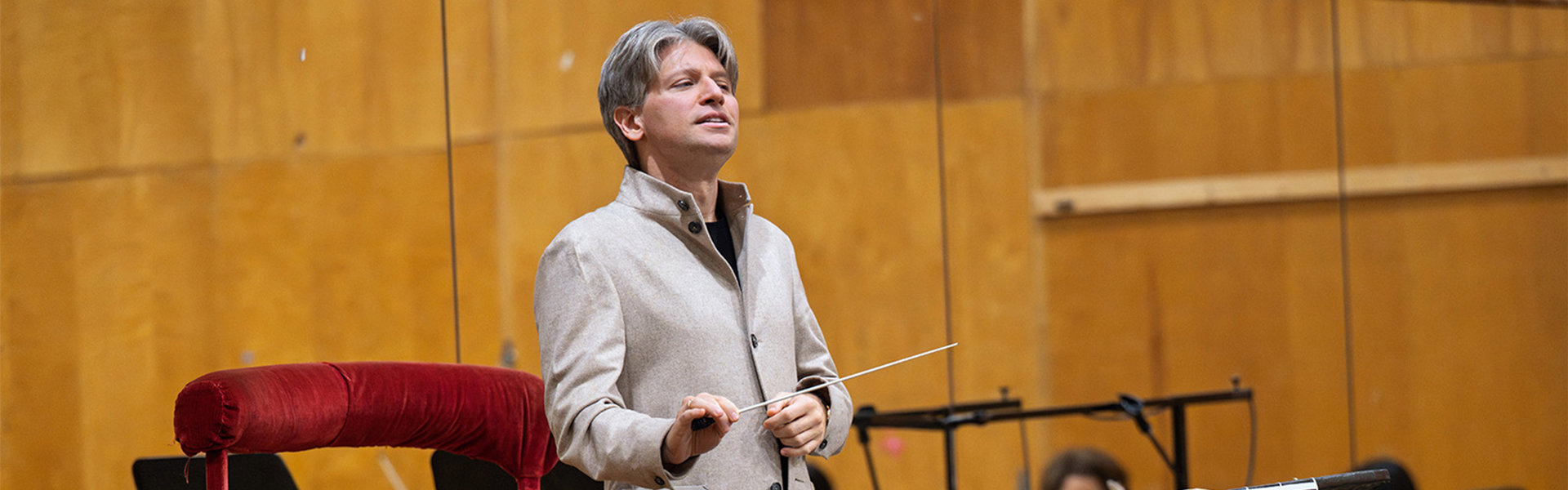
Christened the “torch bearer of Italian tradition” by The New York Times, Daniele Rustioni returns for his sophomore season as Principal Guest Conductor, leading three pillars of the operatic canon he says offer “a musical reward with few equals.” By Christopher Browner
For Daniele Rustioni, taking the podium to conduct Franco Zeffirelli’s beloved production of La Bohème this spring is personal. While he acknowledges that the staging has achieved legend status among Met diehards and opera neophytes alike, he also claims a particularly close connection to the director’s quintessential take on Puccini’s perennial heartbreaker. “In 2012, I had the great privilege of conducting a revival of Zeffirelli’s production at La Scala. Franco came for an entire week, and I still have my score from those rehearsals, filled with his countless annotations and comments,” Rustioni says. “Whenever I conduct this production, I try to preserve the original spirit that Franco envisioned—not simply by reproducing the stage movements but by conveying the humanity, truthfulness, and theatrical vitality that he brought to every scene.” Zeffirelli’s vision for La Bohème is just one of a trio of operas the Milanese maestro will lead in his second season as the company’s Principal Guest Conductor.
At 43 years old, the silver-haired, perpetually smiling Rustioni has already excelled across a wide range of repertory, from the recent new production of Bizet’s Carmen and revivals of Mozart’s Don Giovanni and Le Nozze di Figaro to a high-octane performance of Stravinsky’s Firebird Suite with the Met Orchestra at Carnegie Hall. But it’s in the music of his Italian compatriots that he feels most at home. In January, he’ll kick things off with a powerful one-two punch, leading what he calls “perhaps my two favorite operas in the entire Italian repertoire”—Verdi’s Otello and Puccini’s Tosca. “Otello stands among the highest achievements in the history of music theater,” Rustioni says. “The absolute unity between music and drama is extraordinary, and every note serves the psychological development of the characters. There is an almost physical pleasure for me in conducting this score.” He sees Tosca much the same way, pointing out that every orchestral color, every harmonic shift, and even every silence serves a theatrical purpose, and noting that though the score includes some of the composer’s most indelible melodies, they never disrupt the opera’s breakneck pace. “From the opening chords until Tosca’s final leap, Puccini sustains the dramatic tension with astonishing precision,” he says.
It all has the makings of an electrifying season for Rustioni, who is also eager to continue forging lasting relationships across the opera house. “Stepping into this new role this past year was exciting, but it also felt very natural. From my very first rehearsal, I felt an even deeper sense of collaboration with the orchestra, chorus, singers, and the entire artistic and technical staffs,” he says. But despite scoring high marks with artists on both sides of the footlights, he’s not one to rest on his laurels, adding, “Opera is always about the present moment, and no matter how iconic a production may be, every performance creates something new. That’s the beauty of live theater.”